

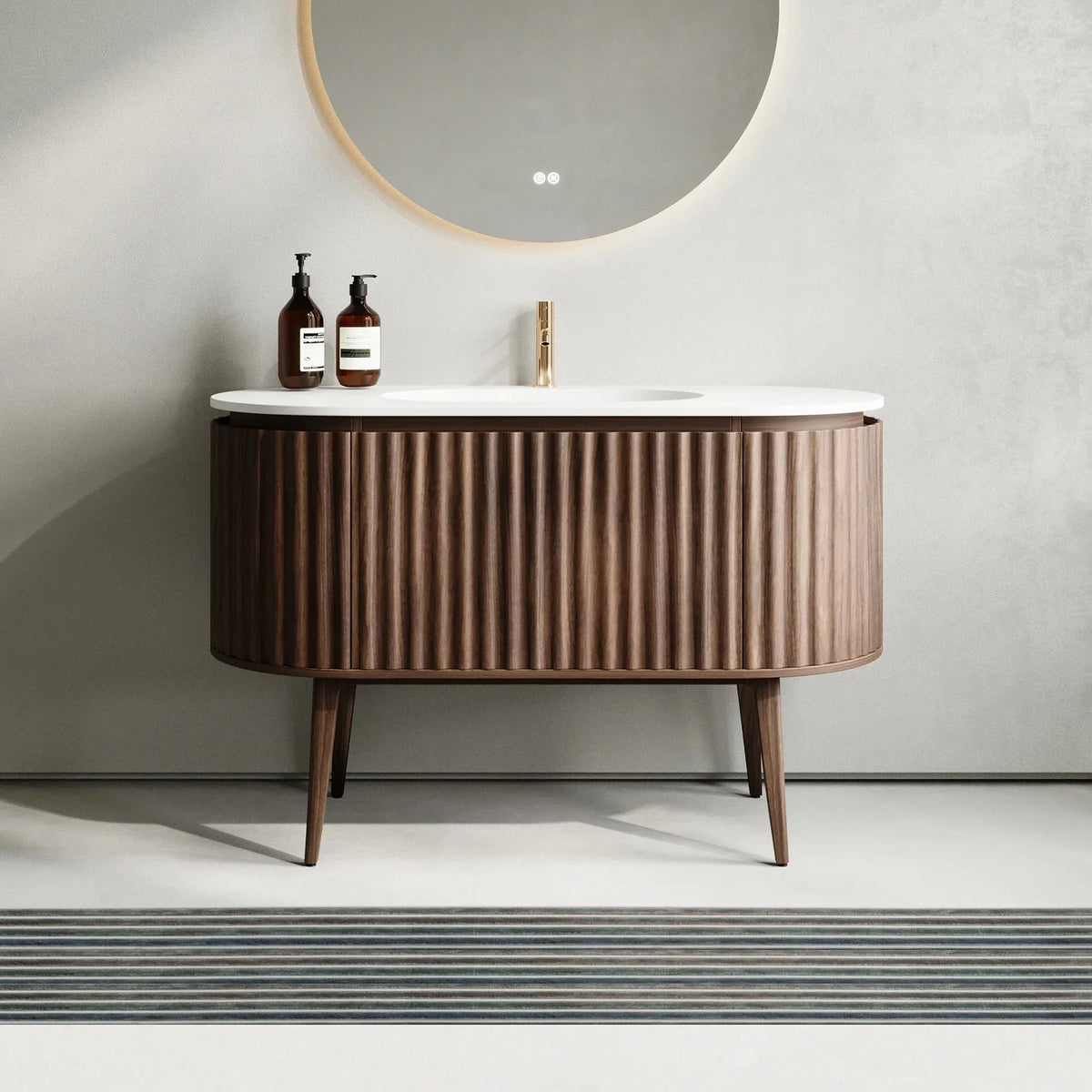
You're standing in the showroom — or scrolling at midnight — and the question keeps coming back: wood or melamine vanity? It sounds simple, but this single choice affects how your bathroom looks, how long your vanity lasts, and yes, how much you'll spend over the next 10–20 years. The good news: this guide breaks it all down so clearly that you'll know your answer before you finish reading.
What Are We Actually Comparing? (Definitions First)
Before we pit wood against melamine, let's make sure we're speaking the same language — because these terms get thrown around loosely at hardware stores and renovation centres.
What Is a Real Wood Bathroom Vanity?
A real wood vanity — sometimes called solid wood — is constructed from natural timber like oak, maple, birch, or walnut. The doors, drawer fronts, and frame are crafted from actual wood, giving each piece a unique grain pattern. Some vanities use solid wood for the frame with plywood panels for the cabinet box, which is still considered high-quality construction.
What Is a Melamine Vanity?
Melamine vanities are built from MDF (medium-density fibreboard) or particleboard that is coated with a melamine resin surface. This coating is heat-pressed onto the board, creating a smooth, durable, and moisture-resistant exterior. The result looks clean and modern — and it's the material you'll find in most mid-range bathroom vanities sold in big-box stores across Quebec.
Pro Tip: Don't confuse melamine with thermofoil or laminate. Melamine is fused directly to the board at high pressure. Thermofoil is a vinyl film that can peel over time, especially near heat sources. Ask your retailer specifically which material the cabinet is made from.
Wood vs. Melamine Vanity: The Full Comparison
Here's where most articles give you a vague table and call it a day. We're going deeper — category by category — so you can weigh what matters most to your specific situation.
1. Durability and Moisture Resistance
This is the big one for bathrooms. Bathrooms in Quebec homes deal with dramatic humidity swings — steam from hot showers, cold winters, and everything in between. Real wood is naturally more susceptible to warping and swelling if it's not properly sealed and maintained. However, a high-quality solid wood vanity with a proper water-resistant finish will hold up beautifully for decades. Melamine, on the other hand, offers excellent moisture resistance right out of the box. Its non-porous surface repels water and doesn't require any sealing. The weak point? The edges and any exposed substrate. If water gets into a chip or an unsealed edge, particleboard underneath can swell and crumble irreparably.
- Wood: Can warp if not properly sealed — but can be refinished and repaired
- Melamine: Excellent surface moisture resistance — but edge damage is often permanent
- Wood: Requires annual inspection of finish and caulking around the sink
- Melamine: Zero maintenance surface — just wipe it clean
2. Aesthetics and Design Versatility
Real wood has something melamine will never be able to replicate: character. The natural grain, the subtle variations in tone, the warmth it brings to a space — these are qualities that homeowners and interior designers consistently rank as the top reason they choose wood. And here's a fact worth anchoring to: 78% of upscale bathroom renovations in North America feature solid wood cabinetry according to NKBA (National Kitchen & Bath Association) reports. Melamine excels in contemporary and minimalist designs. Its perfectly uniform surface is ideal for sleek, handleless cabinetry and high-gloss finishes. If your bathroom aesthetic is inspired by Scandinavian simplicity or ultra-modern European design, melamine might actually be the stronger visual choice.
There's a reason clients always gravitate toward the wood vanities when they walk into a showroom. The warmth is immediate and emotional — you feel it before you even process it consciously.
Interior Designer, Montreal
3. Cost: Initial Price vs. Lifetime Value
Here's where anchoring matters: melamine vanities typically cost 30–50% less upfront than comparable solid wood units. A melamine vanity might run $400–$900, while a solid wood version in the same size could range from $800–$2,500+. But consider this: a real wood vanity that lasts 25 years — and can be refinished, repainted, or repaired along the way — may cost you less over its lifetime than replacing a melamine unit every 8–12 years. Think of it less like buying furniture and more like investing in the bones of your home.
4. Repairability and Longevity
This is where the endowment effect kicks in — once you own a real wood vanity, you truly own it. Scratches can be sanded out. The finish can be refreshed. Hardware can be swapped. You can even repaint it a completely different colour when your design taste evolves in 10 years. Melamine does not offer this flexibility. Chips and scratches in the coating are difficult to repair invisibly, and once the substrate swells from water damage, the unit is essentially done. There's no second life for a melamine vanity.
5. Environmental Impact
Sustainably sourced solid wood is a renewable resource and biodegradable. If you choose FSC-certified wood, you're making one of the most eco-conscious choices available in cabinetry. Melamine involves resins and binding chemicals that make it difficult to recycle. Particleboard also often contains formaldehyde-based binders, though many modern manufacturers have transitioned to low-emission alternatives. If environmental impact is part of your decision, solid wood is the clearer choice — especially when it's sourced responsibly.
So — Wood or Melamine Vanity? Here's How to Decide
Stop overthinking it. Use this simple decision framework based on your actual situation:
- Choose REAL WOOD if: You want a vanity that lasts 20+ years, adds resale value, and can be refinished or repaired
- Choose REAL WOOD if: Your bathroom is a master ensuite you use daily and design quality matters to you
- Choose REAL WOOD if: You're renovating a forever home or a high-end property in the Montreal area
- Choose MELAMINE if: You're flipping a property and need a clean, modern look on a tight budget
- Choose MELAMINE if: It's a secondary bathroom with low daily traffic
- Choose MELAMINE if: Your design aesthetic is ultra-modern and you want the perfectly flat, uniform surface
Pattern Interrupt: Most people assume melamine is the 'smart, practical' choice. But in a humid Quebec bathroom, a properly sealed solid wood vanity can actually outlast a melamine unit by 10+ years — making it the more practical choice in the long run.
How to Shop for a Real Wood Bathroom Vanity: 5 Steps
If you've landed on real wood as your choice — here's exactly what to look for so you don't overpay or get burned by a product marketed as 'wood' that's mostly MDF with a wood veneer face.
- Step 1 — Ask what the cabinet box is made of. A solid wood door on an MDF box is not a solid wood vanity. Look for plywood or solid wood carcasses.
- Step 2 — Check the finish. Ask if it's water-resistant, how many coats were applied, and whether it's been tested for bathroom humidity conditions.
- Step 3 — Inspect the joinery. Dovetail drawer joints and mortise-and-tenon construction signal real quality. Staple-and-glue is a red flag.
- Step 4 — Look at the hardware. Soft-close hinges and full-extension drawer slides indicate a manufacturer who cares about the full product — not just the exterior.
- Step 5 — Verify the wood species. Oak and maple offer excellent hardness and moisture resistance. Avoid soft woods like pine in wet bathroom environments.
Browse Our Real Wood Bathroom Vanities
At Golden Elite Deco, our real wood bathroom vanity collection is curated for Quebec homeowners who want craftsmanship that holds up to our climate, our daily routines, and our standards. Every piece in this collection is selected for its construction quality, finish durability, and timeless design — so you're not just buying a vanity, you're investing in a feature that will define your bathroom for decades.
Final Verdict: Wood Wins on Value, Melamine Wins on Budget
If you're making a long-term investment in your home, the wood or melamine vanity debate doesn't need to be complicated. Real wood offers unmatched character, repairability, and long-term durability — especially when sealed and maintained properly in a Quebec bathroom. Melamine is a solid choice for lower-traffic spaces and budget-conscious flips. But if you're renovating a space you'll live in and love every single day, the warmth and permanence of real wood is worth every extra dollar. When in doubt, come visit us at Golden Elite Deco in Montreal — touch both materials in person, and you'll feel the difference immediately.
A bathroom vanity isn't just storage. It's the first thing you see every morning and the last thing you see every night. Make it something worth looking at.
Golden Elite Deco Design Team


