

You want the beauty of real hardwood floors, but you've heard they're not ideal for every room or climate. Maybe you have a basement you'd love to finish, or you're worried about how traditional hardwood will handle Quebec's temperature swings.
Enter engineered hardwood flooring. It gives you the authentic look and feel of solid wood—because the top layer IS real wood—but with better stability, more installation options, and the ability to go places solid hardwood can't.
In this guide, we'll break down exactly what engineered hardwood is, how it compares to solid wood, where it works best, and what to look for when shopping.
What Is Engineered Hardwood Flooring?
Engineered hardwood is real wood flooring, but constructed differently than traditional solid hardwood. Instead of a single piece of wood from top to bottom, engineered planks are built in layers.
The top layer (called the wear layer or veneer) is genuine hardwood—oak, maple, walnut, hickory, or any species you'd find in solid hardwood. This is what you see and walk on, and it's indistinguishable from solid wood once installed.
Below the veneer is a core made of multiple layers of plywood or high-density fiberboard (HDF), stacked with the grain running in alternating directions. This cross-grain construction is the secret to engineered hardwood's stability—it resists the expansion and contraction that plagues solid wood in changing humidity conditions.
Important note: Don't confuse engineered hardwood with laminate flooring. Laminate has a printed image of wood under a clear protective layer—it's not real wood at all. Engineered hardwood has a genuine wood surface.
Engineered vs. Solid Hardwood: Key Differences
Both are real wood floors, but they behave differently. Here's how they compare:
|
Factor |
Engineered Hardwood |
Solid Hardwood |
|
Construction |
Wood veneer over plywood/HDF core |
Solid wood throughout |
|
Stability |
Excellent—resists expansion/contraction |
Expands/contracts with humidity |
|
Installation |
Float, glue, or nail—very flexible |
Nail-down only (wood subfloor required) |
|
Where to Install |
Any level, including basements, over concrete |
Above-grade only, wood subfloors |
|
Refinishing |
1-4 times (depends on veneer thickness) |
Many times over its lifespan |
|
Cost |
$4-$10/sq ft typically |
$6-$12/sq ft typically |
|
Lifespan |
20-50+ years (varies by quality) |
75-100+ years with refinishing |
Why Choose Engineered Hardwood?
Engineered hardwood has become incredibly popular—now accounting for about 30% of all wood flooring sold in North America. Here's why:
Better Stability in Changing Conditions
This is the biggest advantage. The cross-grain construction makes engineered hardwood far less susceptible to expanding and contracting with humidity changes. For Canadian homes that experience significant seasonal temperature and humidity swings, this matters a lot.
Can Be Installed Almost Anywhere
Unlike solid hardwood, engineered flooring can be installed over concrete slabs, in basements, and even over radiant heating systems. This opens up wood flooring possibilities for rooms that were previously off-limits.
Multiple Installation Methods
You can nail it down, glue it down, or float it (click-lock installation). The floating method is particularly popular because it's faster, more affordable, and DIY-friendly.
Often More Affordable
Because less hardwood is used per plank, engineered flooring typically costs less than solid hardwood of the same species. This is especially noticeable with exotic or premium woods.
Environmentally Friendly
Engineered hardwood uses wood more efficiently—the veneer is sliced rather than sawn, producing less waste. Fewer slow-growing hardwood trees are needed compared to solid wood flooring.
Understanding Wear Layer Thickness
The wear layer (veneer) thickness is one of the most important specs to check when shopping for engineered hardwood. It directly impacts durability, refinishing potential, and lifespan.
• 1-2mm veneer: Entry-level. Can be recoated but not fully sanded and refinished. Lifespan of 20-30 years with good care.
• 2-3mm veneer: Mid-range. Can typically handle 1-2 light refinishes. Lifespan of 30-40 years.
• 4mm+ veneer: Premium quality. Can be refinished 3-4 times, similar to solid hardwood. Lifespan of 50+ years, potentially up to 100 with proper care.
Our recommendation: For high-traffic areas or if you want long-term value, invest in a thicker wear layer (3mm minimum). The upfront cost difference is minimal compared to the extended lifespan.
Where to Install Engineered Hardwood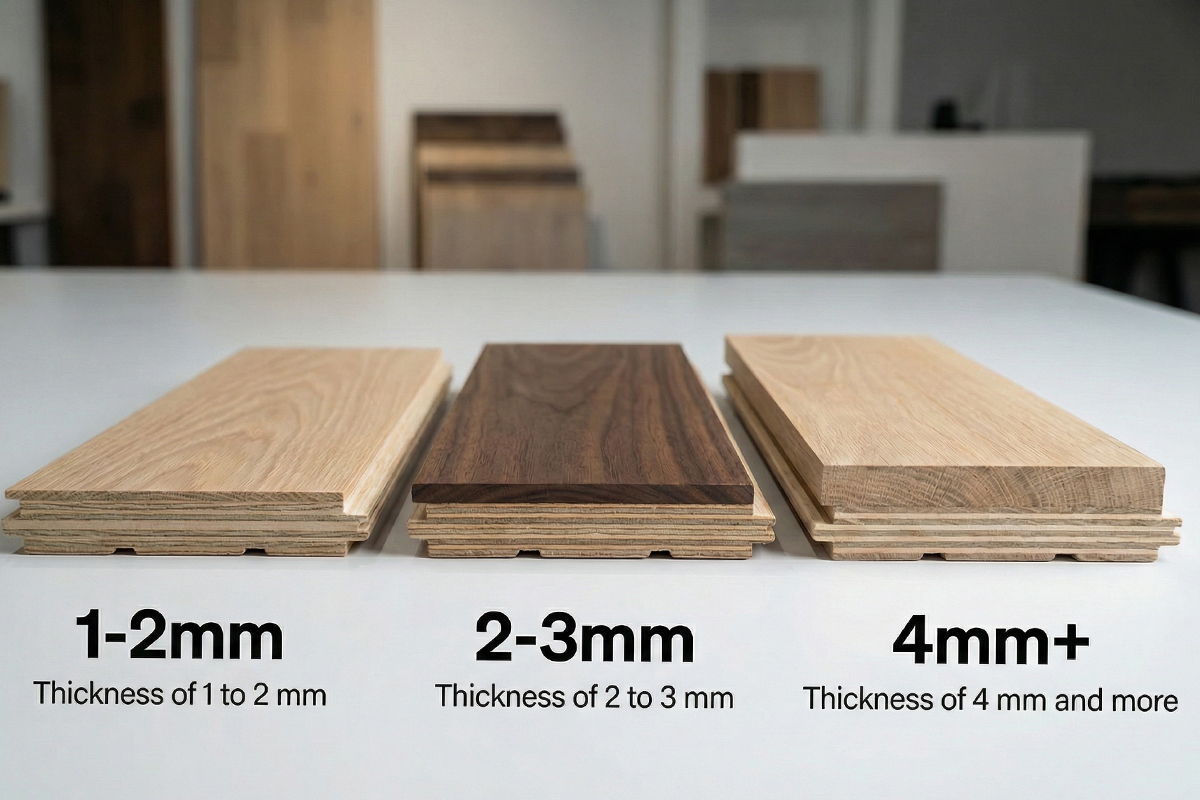
One of engineered hardwood's biggest advantages is its versatility. Here's where it works well:
Ideal Locations
• Living rooms and bedrooms: Classic choices where engineered hardwood shines.
• Basements: Unlike solid hardwood, engineered can handle below-grade installation over concrete.
• Over concrete slabs: Perfect for condos or slab-on-grade homes.
• Kitchens: Better moisture resistance than solid wood makes it a reasonable choice (with precautions).
• Over radiant heating: The dimensional stability handles temperature fluctuations well.
Proceed with Caution
• Bathrooms: Engineered hardwood is moisture-resistant, not waterproof. Consider SPC flooring for bathrooms instead.
• Laundry rooms: High risk of water exposure makes waterproof options a better choice.
Installation Methods Explained
Engineered hardwood offers flexibility in how it's installed:
Floating (Click-Lock)
Planks snap together and "float" over an underlayment without being attached to the subfloor. This is the fastest, most affordable method and is DIY-friendly. Great for basements and over concrete.
Glue-Down
Planks are adhered directly to the subfloor with adhesive. Creates a very stable floor with minimal sound. Best for concrete subfloors and high-traffic commercial areas.
Nail/Staple-Down
Traditional method where planks are nailed or stapled to a wooden subfloor. Provides the most solid feel underfoot but requires a wooden subfloor and professional installation.
Popular Wood Species
Engineered hardwood comes in virtually every species available in solid wood. Here are the most popular choices:
• Oak: The most popular choice. Durable, classic grain pattern, available in many stain colors. Works with any décor style.
• Maple: Light color, subtle grain. Creates a clean, contemporary look. Very hard and durable.
• Walnut: Rich, dark brown tones with distinctive grain. Softer than oak, so better for lower-traffic areas.
• Hickory: Dramatic grain variation, extremely hard and durable. Great for high-traffic areas and rustic styles.
• Exotic species: Brazilian cherry, teak, acacia—engineered construction makes these more affordable than solid versions.
Maintenance Tips
Engineered hardwood requires similar care to solid hardwood:
1. Sweep or vacuum regularly. Dirt and grit act like sandpaper, scratching the finish over time.
2. Clean spills promptly. While more moisture-resistant than solid wood, standing water should still be avoided.
3. Use furniture pads. Prevent scratches and dents from heavy furniture.
4. Use appropriate cleaners. Avoid harsh chemicals. A damp mop with a pH-neutral cleaner is best.
5. Control humidity. Keep indoor humidity between 35-55% for optimal performance.
Complete Your Space
Beautiful floors deserve a beautiful room. Consider pairing your new engineered hardwood with:
• A coordinating vanity: If you're extending hardwood near a bathroom, a bathroom vanity in complementary tones ties the spaces together.
• Modern lighting: An LED mirror adds contemporary elegance to adjacent bathrooms.
• Smart storage: Keep your new floors clutter-free with stylish storage solutions.
Ready to Explore Engineered Hardwood?
Engineered hardwood gives you the warmth and beauty of real wood with added stability, installation flexibility, and the ability to use it in more areas of your home. For Canadian homeowners dealing with seasonal humidity changes, it's often the smarter choice over solid hardwood.
Whether you're finishing a basement, upgrading your main floor, or looking for flooring that works with radiant heat, engineered hardwood delivers the look you want with the performance you need.
Browse our collection of engineered hardwood flooring to see the species and styles available, or contact us for help choosing the right flooring for your project.


