

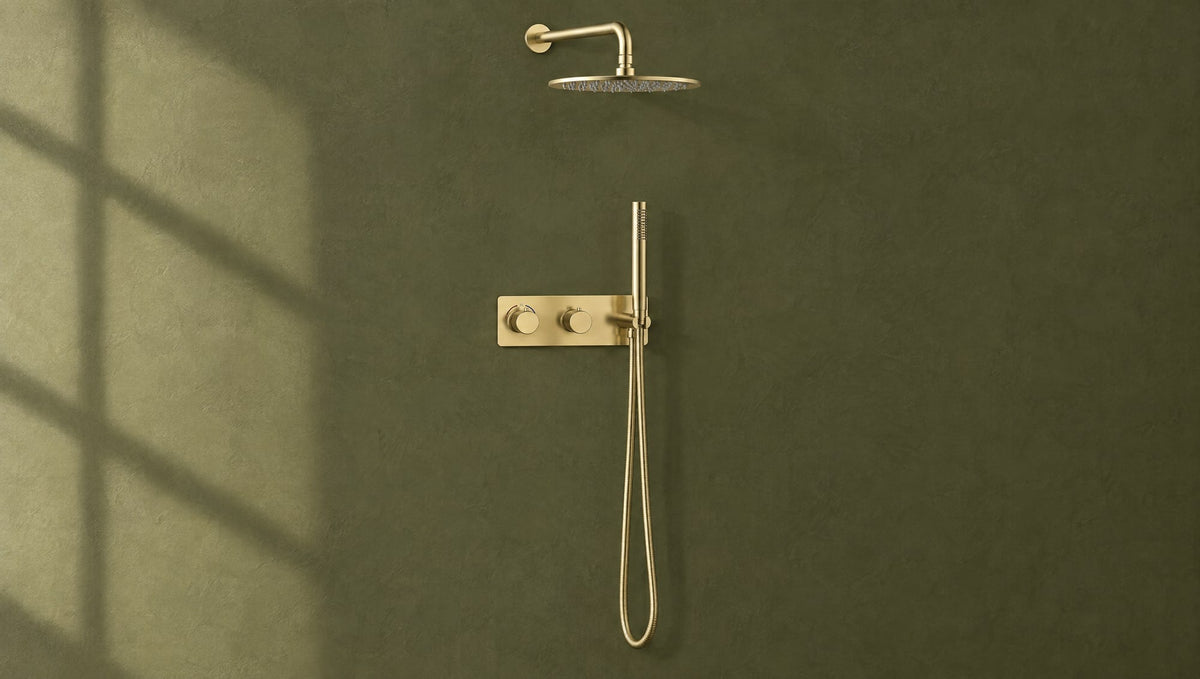
Someone flushes a toilet while you are in the shower, and the water turns hot. The shower valve is the part meant to stop that. Two types do the job: the pressure balance valve and the thermostatic shower valve. They are often confused, and the difference decides how your shower feels every day for the next twenty years, because the valve is closed inside the wall.
This guide explains how each shower valve works, where each one is the better choice, and what to check before you buy. The examples are our own shower faucet kits, which all come with their valve.
- A pressure balance valve keeps the mix of hot and cold steady when the pressure on one side drops. The temperature stays within about 2 °C.
- A thermostatic valve measures the temperature of the water and corrects it. You set a temperature, usually 38 °C, and it holds it.
- Both protect against scalding. Canadian plumbing codes ask for one or the other in a shower.
- Choose pressure balance for a simple, dependable shower. Choose thermostatic for exact temperature, for young children or older adults, or when the hot water supply varies.
What a shower valve does
The shower valve sits behind the wall, where the hot and cold pipes meet. It mixes the two and sends the water to the rain head, the hand shower or the tub spout. What you see and touch in the shower is the trim: the plate and the handles.
A plain mixing valve only mixes. If the cold pressure drops because a toilet is filling or a washing machine starts, the shower gets hotter at once. This is why Canadian plumbing codes ask for a shower valve that is pressure-balanced or thermostatic, and limit the hot water at the shower to 49 °C. Your plumber will know the rule that applies where you live.
How a pressure balance valve works
Inside a pressure balance valve, a small piston or diaphragm sits between the hot and the cold inlets. When the pressure falls on one side, it moves and narrows the other side by the same amount. The proportion of hot to cold stays the same, so the temperature does too. If the cold water stops completely, the valve cuts the hot down to a trickle.
The valve does not know how warm the water is. It only compares pressures. It protects you from the toilet flush, and it does that very well, but it cannot correct a water heater that is running out of hot water. On the Seren and Vero sets, the pressure balance cartridge holds the water within ±2 °C, and a limit stop sets how far the handle can turn toward hot.

Shower sets with a pressure balance valve
 Seren, matte black10" rain head and hand shower
 Vero, chromeHand shower on a slide bar
 Luna, chrome10" rain head and hand shower
 Verona, brushed gold8" rain head and hand shower
How a thermostatic shower valve works
A thermostatic shower valve has a temperature-sensitive element in the stream of mixed water. The element expands when the water warms and contracts when it cools, and that movement opens or closes the hot and cold inlets. The valve reacts to the temperature itself, whatever the cause: a pressure drop, a water heater that is cooling down, or colder supply water in January.
A thermostatic valve also separates the two settings. One control sets the temperature and another opens the water. You leave the temperature where you like it and only turn the water on and off, so the shower is the same every morning. You can also lower the flow without changing the temperature.
On the Arvo thermostatic shower set, the temperature control is marked at 38 °C, about the temperature of a comfortable shower, and the valve leaves the factory limited to 56 °C. The installer can lower that limit.

Thermostatic shower sets
 Arvo, brushed gold10" rain head and hand shower
 Barbados, matte blackSquare head, slide bar hand shower
 Bali, chromeThree functions, with tub spout
 Halo column, matte blackMounted on the wall surface
Thermostatic vs pressure balance: side by side

| Pressure balance valve | Thermostatic valve | |
|---|---|---|
| What it senses | The pressure of the hot and cold water | The temperature of the mixed water |
| Toilet flush or washing machine | Temperature stays within about 2 °C | Temperature stays at the set point |
| Water heater running low | The shower cools down with it | Adds hot water to hold the temperature for as long as there is some |
| Setting the temperature | Found by hand each time, up to a limit stop | Set once, on a marked control |
| Flow and temperature | On most models, tied to the same handle | Separate controls |
| Scald protection | Yes | Yes |
| Price | Usually lower | Usually higher |
When a pressure balance valve is the right choice
- You want a dependable shower and a simple control.
- The house has a water heater with capacity to spare and steady pressure.
- It is a guest bathroom, a basement shower or a rental unit.
- You would rather put the budget into the finish, the rain head or the hand shower.
Pressure balance is the standard in Canadian homes and it meets the plumbing code. Sets such as the Luna and the Verona in brushed gold give you a rain head, a hand shower and the valve in one box.
When a thermostatic shower system is worth it
- Young children or older adults use the shower: the temperature is set once and does not depend on how far a handle is turned.
- Several people shower one after the other and the water heater runs low.
- You want the same temperature every day without searching for it.
- You like a long shower at a lower flow.
- The shower has a rain head and a hand shower, and you switch between them often.
Thermostatic sets used to be far more expensive. Today the gap is small: the Barbados and the three-function Bali, which adds a tub spout, sit in the same range as our pressure balance sets.
What to check before you buy a shower valve kit
- The valve goes in before the wall is closed. A concealed shower valve is soldered or threaded to the pipes inside the wall. Changing from one type to the other later means opening the wall or the tile. Decide during the renovation, before the shower walls go up.
- Check that the valve is included. Many shower systems are sold as trim only, and the valve is a separate purchase. Every kit in this guide includes its valve, and the trim, rain head and hand shower match it.
- Count the functions. A 2-function set feeds a rain head and a hand shower. A 3-function set adds a tub spout or a second outlet.
- Look for the certification. In Canada, a shower valve should be certified to ASME A112.18.1 / CSA B125.1. The cUPC mark on the spec sheet shows it was tested by a third party.
- No access to the pipes? Use a shower column. An exposed thermostatic shower column such as the Halo mounts on the surface of the wall and connects to the existing hot and cold outlets. The wall stays closed.
Thermostatic and pressure balance valves: frequently asked questions
Is a thermostatic shower valve better than a pressure balance valve?
It controls the temperature more precisely, because it measures the water temperature instead of the pressure. A pressure balance valve is simpler and usually costs less, and it handles the most common problem, the pressure drop when someone else uses water. Both are safe, code-compliant choices.
Do both valves prevent scalding?
Yes. A pressure balance valve prevents the sudden burst of hot water when the cold pressure drops, and its limit stop caps how hot the handle can go. A thermostatic valve holds a set temperature and has a high-temperature limit.
Why does my shower get hot when someone flushes the toilet?
The toilet takes cold water, the cold pressure at the shower drops, and the mix turns hotter. It means the shower has a plain mixing valve, or a pressure balance cartridge that is worn. A pressure balance or thermostatic valve corrects it.
Can I replace a pressure balance valve with a thermostatic valve?
Yes, but the valve body inside the wall has to be changed, not only the handles. Plan it with a bathroom renovation, when the wall is open, or choose an exposed thermostatic shower column that needs no valve in the wall.
Does a thermostatic valve save water?
It can. The temperature is right as soon as the water arrives, so less water runs while you adjust, and you can reduce the flow without changing the temperature.
What temperature should a thermostatic shower valve be set to?
Most people shower at about 38 °C, which is why thermostatic controls are marked at 38 °C. Canadian plumbing codes limit the water at the shower to 49 °C.
How long does a shower valve last?
The valve body lasts for decades. The cartridge inside is the wearing part, and it can be replaced from the front, through the trim, without opening the wall.
Where to buy a thermostatic or pressure balance shower set in Canada
The teams in our four showrooms in the Montreal area can help you choose between the two. Our shower faucet kits are delivered across Canada, and single pieces are in shower heads and parts. Finishing the shower? See our glass shower doors. Not sure which valve suits your plumbing? Write to us.


